
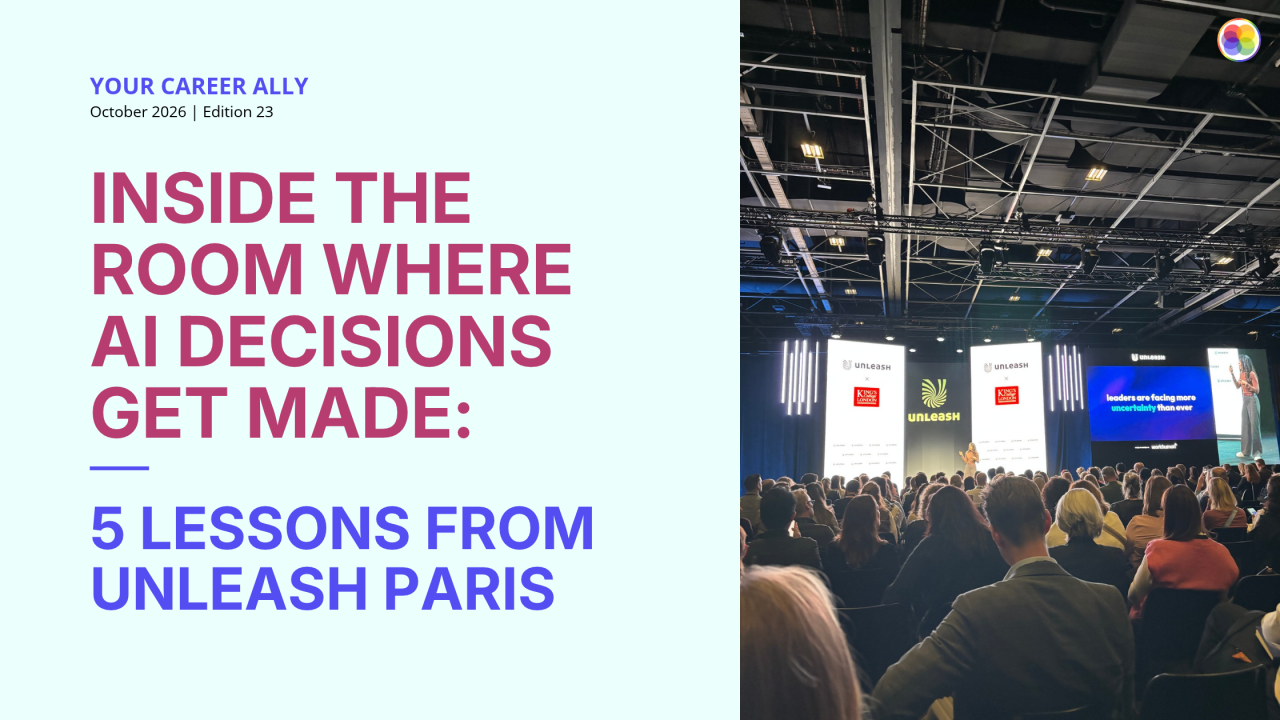
Inside the room where AI decisions get made: 5 lessons from Unleash Paris
What the people who will redesign your job are planning, and what it means for your next career move.
This week, I was supposed to be in California, speaking at the Grace Hopper Celebration about moving from tech to climate. Life decided otherwise. The conference was cancelled, and instead of rehearsing my talk, I booked a last-minute ticket to Paris.
Unleash is where the global HR world meets. The organisers announced 8,500 attendees from 140 countries, including the chief people officers of companies like SAP, bp, AXA, Orange and Lloyds Banking Group – many of them sharing their reflections and strategies from the stage. These are the people who decide how AI enters the workplace, which roles change, and who gets hired next.
In my first post from Paris, I described what I call the AI Optimism Ladder. Individuals worry. Practitioners weigh benefits against risks. The leaders designing entire workforce systems see a once-in-a-lifetime opportunity. The organisers even promoted the event as an antidote to the doom and gloom around AI and jobs.
I went to listen to the top of the ladder. Here are five lessons I brought home, and what each one means for you if you are building your career, changing direction, or job hunting right now.
1. AI is the new email
Paris confirmed my gut feeling: there is no way to escape AI at work. As Peter Hinssen, co-founder of nexxworks, put it on stage: “If you don’t take the change by the hand, it will take you by the throat.”
I think of my dad. When the world moved from phone and fax to email and digital communication, he never made the switch. He was lucky. He ran his own small company, and someone else handled it for him.
Most of us won’t have that privilege with AI. The leaders I listened to are not asking whether to adopt it. They are asking how, and with whom. Josh Bersin described the journey as a J-curve: a slow, difficult start, then rapid value. In his view, we are at the bottom of the curve and starting to climb. Hinssen also warned that by the time you get back from lunch, the industry has already changed.
The business environment won’t wait. It will reward the people who get on with AI early and use it to create new solutions. Those who don’t may find their career choices narrowing, quietly but substantially.
Your move: pick one recurring task in your week and do it with AI every time for a month. Fluency comes from experimenting and repetition, not from reading about it!
2. Work is being redesigned around AI, but centered on people
Here’s the good news. The leaders in Paris see the future of work designed around AI capabilities, but centered on human potential. Several speakers framed it as a shift from “human resources” to “human potential”.
They understand that the real gain comes from integrating AI into the workforce, not from substituting people with it. They talk about “superjobs”, where people design the systems and machines carry them out. Work is increasingly organised around outcomes rather than tasks or job titles.
The strategic workforce planning panel, with Richard Skellett of Bloor Research and leaders from Orange Business, Panasonic Automotive and Nationwide, pushed this further. Their provocation: organisations no longer need a workforce plan. They need a workforce architecture, because the workforce now includes bots, AI agents, digital twins, contractors and gig workers alongside internal employees. AI should sit in the loop with humans, with people upstream, not as a fallback after the machine.
The panel also named the risk. If roles aren’t redesigned intentionally around human potential, and automation becomes widespread, people end up with the hollow “leftover” tasks, then burn out or quit.
Your move: in your next interview, ask: “How is AI changing this role over the next two years?” The answer tells you whether you’re being hired into a superjob or into the leftovers.
3. From T-shaped to F-shaped professionals
IMD’s Howard Yu warned that single-skill workers are most exposed to AI: the lawyer who only reads contracts, the procurement manager who only knows inventory. His answer is the “plus one”: deep expertise plus one adjacent capability.
He told the story of a process engineer at Mars who built an augmented-reality training system for factory changeovers. Supervisors ignored it, until COVID made in-person training impossible. The system then scaled globally, and the engineer ended up presenting to the management board.
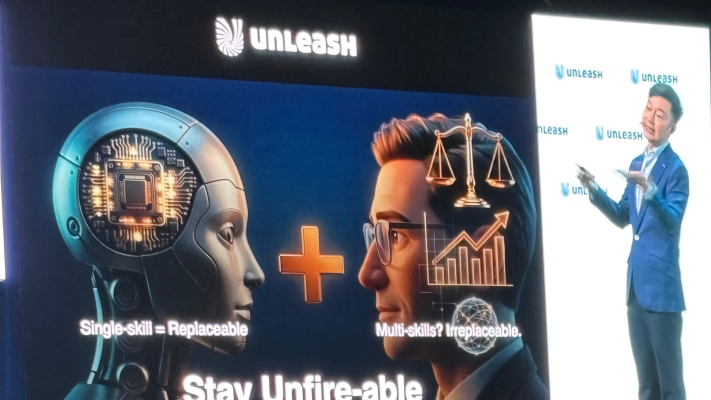
I believe we are moving beyond the T-shape. What I see coming is the F-shaped professional, with three strokes instead of two:
- Sector expertise: the deep knowledge of your field that lets you understand the real problems and question AI’s outputs.
- Technological fluency: using AI as a co-pilot to apply that expertise in new ways.
- Unique human skills: judgement, critical thinking, creativity, empathy and relationship building: the human potential leaders want AI to amplify.
Your domain expertise will likely stay valuable. But without AI fluency, you can’t apply it at the speed the market now expects. And without the human layer, you compete with the machine without your best weapon: the human value it cannot replace.
Your move: name your three strokes. If one is missing, that’s your learning plan for the next six months. More on this in an upcoming post.
4. The digital gatekeeper is already here
Just today, I shared my interview with Lizzy, an AI recruiter, in a LinkedIn post. It was funny, slightly awkward, and a glimpse of where hiring is going.
Employers are building a digital gatekeeper: a layer of AI that candidates must pass through before a human recruiter ever sees them. Think of it as an ATS on steroids. In the vision I heard, AI sources, verifies and shortlists candidates. The recruiter steps in only for the final interview and reference checks.
This is not a distant scenario. Josh Bersin named talent acquisition as one of three priority starting points for HR teams adopting AI, because it is a 15 to 20 step process where the return on investment is already proven.
For candidates, this means a new skill: communicating effectively with the machine. You may need to make your profile findable by AI sourcing tools, fill in screening questionnaires, answer a call or a WhatsApp message from a bot, and interview with an avatar.
We already do this as consumers. Think of how many times you’ve typed “I want to talk to a human” to a customer-service bot. Recruiting is going the same way.
Your move: run my Gatekeeper Test on your job search.
- Can AI find me? Is my profile complete, specific and visible?
- Can AI read me? Do I answer with concrete examples, not one-liners?
- Am I still me? Do I show up as if a human is watching? Eventually, one will.
5. Your next job may not exist yet, so build it at the edge
This is the part I find most hopeful, especially for anyone who wants to pivot or reinvent themselves.
Many roles and tasks as we know them today will likely be gone in five years. Take someone whose job is scheduling shifts for staff. AI can analyse the data and distribute shifts more fairly and efficiently. So what happens to that person?
They could leave and hope to reskill into something new. Or they could use what they already know: the staff’s preferences and pain points, and how the organisation really works. With that knowledge, they could become the orchestrator of scheduling systems for the whole organisation. Or they could move into designing the wider employee experience.
Those jobs don’t have titles yet. They are up for grabs. A month ago, at the AI Summit in Barcelona, I heard of the forward deployed engineer for the first time: someone who comes in at the start of AI adoption and combines technical skills with people skills.
Employers are already hiring this way. Roy Baladi, founder and CEO of Kanz, which trains people in AI and connects AI-fluent talent with employers across the Middle East, shared their approach: instead of asking candidates for CVs and cover letters, they give them a space to build solutions with AI, which makes them visible to employers. Building with AI is the new proof of capability, because it takes subject expertise, creativity, systems thinking and AI fluency all at once.
What makes this possible: companies are now ready to fund experiments that fail. Their logic: innovate at the edge, with small projects where failure is fine, then bring what works into the core.
Howard Yu used McDonald’s as an example. As he told it, the company’s first AI voice ordering at drive-throughs, built with IBM, failed publicly. McDonald’s ended that partnership, kept the learning and is relaunching with Google.
Neuroscientist Anne-Laure Le Cunff brought the same idea down to the individual: swap rigid goals for tiny experiments, set a duration in advance, then persist, pivot or pause.
If you find yourself at the edge of your organisation, that’s the best place to be right now. If your AI experiment fails, you are unlikely to be penalised. If it works, you may be the one who helps bring it to the core.
Your move: run one tiny AI experiment on a real problem in your field for four weeks, then share what you learned publicly. That is your new portfolio. Not inside an organisation? Build your own project.
What sits underneath it all: trust
One point united every speaker. AI transformation rests on culture, trust and transparency. They sit at the bottom of the pyramid. Without trust and readiness for change from the bottom up, AI adoption fails.
Nationwide’s talent marketplace works, the panel explained, because employees choose to share their skills and goals. Within a year, the top skill people were developing shifted from admin and office software to AI. That shift came from the people, not from a mandate.
In June, at an AI event for policy-makers in Brussels, the OpenAI Chief Economist, Ronnie Chatterji, told me the best way to prepare for the AI revolution is to stay human. In Paris, the HR leaders, who think in systems rather than individuals, kept asking for people who are willing to learn, adapt and design something new. Not necessarily the deepest experts, but those who take the opportunity by the horns, even at the risk of falling off. Taking risks, experimenting and persisting: that, too, is deeply human.
The future of work will belong to the most agile, curious and creative among us. AI development won’t stop. We can get on the train now and help steer it, or be pulled on board later with no say in where it goes.
Coming up in Notes from Unleash
In my next posts, I’ll go deeper into some of these lessons, for example the F-shaped professional or why AI is the new email. Follow along, or tell me what sparks your interest.
And if you’re rethinking your own career in light of all this, or want me to share my insights with your team, send me a message.
Which of these five lessons hits closest to home for you right now? Tell me in the comments.
— Magda
